TrialOps
Remove the waiting, not the safeguards. TrialOps is a team of five AI agents for clinical trial operations. They check every change and draft the plan. People approve every decision.
The Design Challenge
How might a person stay in control while a team of agents does the work?
The brief asked for one complete journey that shows what a person needs to understand or decide, how they act, and how the system responds. It pointed at delegating roles, seeing each agent's plan, checkpoints before irreversible actions, agents that are unsure, and a clear record of who did what and why.
We skipped the starter scenario and brought our own problem, one where an agent getting it wrong has real consequences.
USER PROBLEM
The science isn’t what slows a trial down. The coordination is.
A trial coordinator moves one participant’s status between the CTMS, eReg binder, EDC, lab portals and email, by hand.
1 coordinator. 20+ systems. 40 participants.
of trials miss their enrollment timelines
to run one Phase III trial for one day
of monitors say disconnected systems are their #1 source of wasted effort
protocol deviations per trial, 2020 to 2024
WHERE THE TIME GOES
Seven stages. Seven places to wait.
Site startup
167daysmedian activation at cancer centers
Recruitment
<0.2%of patients get referred by their doctor
Screening
36.3%of screened patients fail (57% in CNS)
Consent + documents
260daysto fully roll out one protocol amendment
Visits + retention
19.1%of participants drop out
Labs + data
16.4daysto resolve a lab-data query
Compliance
296deviations per trial, up 56% in 5 years
Sources: AACI 2018, Tufts CSDD, Veeva clinical data survey.
COVID proved the waiting can go. Vaccines went from a 10 to 15 year timeline to about 11 months, and nobody skipped a safety stage. Phases ran side by side, so no one waited on the next handoff.
Sources: Tufts CSDD, Veeva Clinical Data Industry Research, McKinsey, BioSpace.How might we remove the waiting from clinical trials without removing a single safeguard?
That second half is the real design problem. In a regulated setting, “let the AI handle it” is not an option, so the agents have to be fast and visibly powerless.
Five days with no access to a live trial site meant I couldn’t interview coordinators, so I built the problem from the people who’ve measured it: Tufts CSDD puts protocol deviations at 296 per trial, up from 189 in 2020, and 71% of monitors in Veeva’s survey name disconnected systems as their top source of wasted effort. The COVID vaccine timelines changed our direction. We started with “make trial operations faster,” but Operation Warp Speed didn’t skip a single safety stage. It ran them side by side and removed the waiting between handoffs. That became our brief: remove the waiting, not the safeguards. As a team, we chose a high-stakes scenario where an agent’s mistake has real consequences, printed each agent’s “never” in the interface, and routed the eligibility call to the principal investigator instead of the coordinator.
PROPOSED SOLUTION
Agents propose. People decide.
When something changes, like a lab result, five agents check what it touches, draft a plan, and stop. A coordinator or investigator reviews it, decides, and only then does anything get written to a system. Each agent ships with a “never” that is printed right in the UI, because I wanted the limits to be as visible as the abilities.
Eligibility
Checks every new result against the protocol.
Never makes the eligibility call.
Scheduling
Maps every visit, chair and lab kit a change touches.
Never cancels without approval.
Documentation
Tracks consent versions and missing forms.
Never signs or edits source records.
Compliance
Rates deviation risk before it happens.
Never closes or reports a deviation.
Recruitment
Pre-screens backup candidates from the pipeline.
Never contacts patients without approval.
DESIGN PRINCIPLES
Three rules for the hard calls.
When something changes, like a lab result, five agents check what it touches, draft a plan, and stop. A coordinator or investigator reviews it, decides, and only then does anything get written to a system. Each agent ships with a “never” that is printed right in the UI, because I wanted the limits to be as visible as the abilities.
Trust is earned in the details
An agent never just says “ineligible.” It shows the value, the rule, the timing window and the exact protocol text.
Read only until approved
Nothing changes in the CTMS, eReg or EDC before a person signs. The UI says it out loud: “0 systems changed.”
Authority stays human
Agents recommend. They can’t sign. Every decision is attributed and timestamped.
THE JOURNEY
One Tuesday morning, end to end.
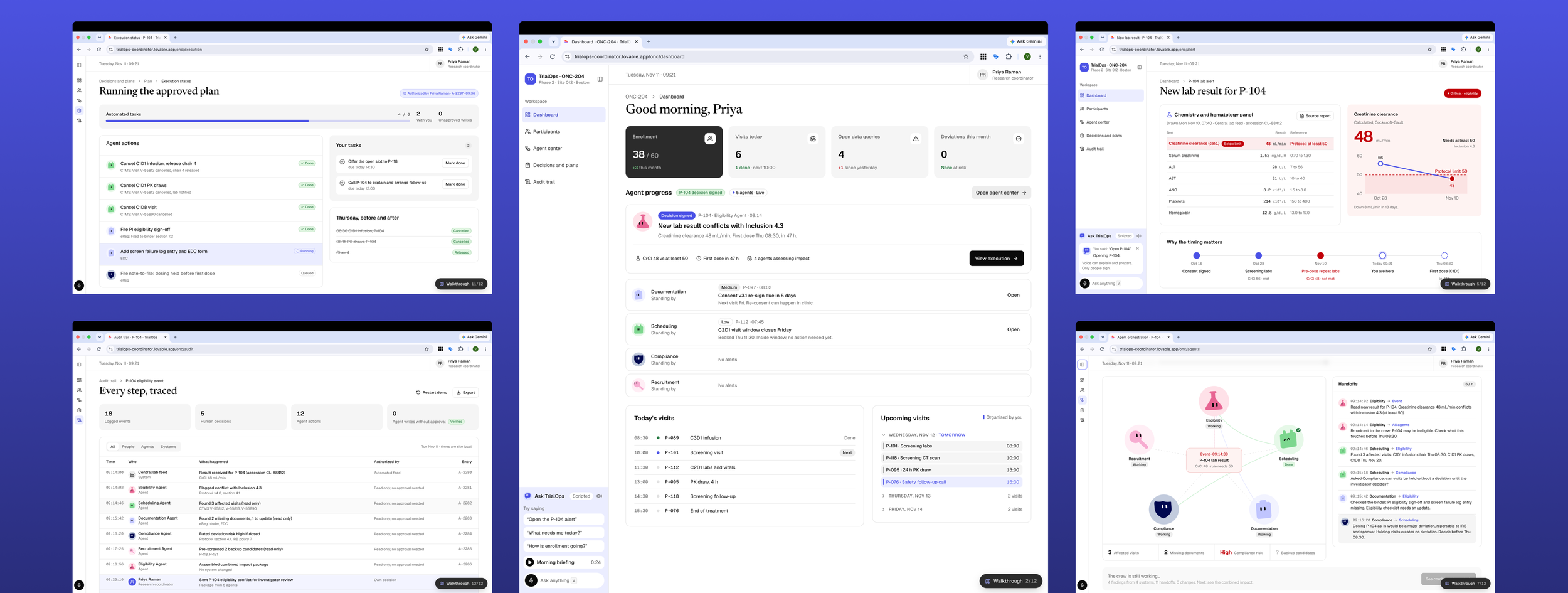
09:14. A lab result for participant P-104 shows creatinine clearance at 48 mL/min. The protocol needs at least 50 within 72 hours of first dose. First dose is Thursday at 08:30, 47 hours away. Today that conflict can sit in a query for 16.4 days.
01 · DASHBOARD
Exceptions are buried across 20+ systems and a shared inbox.
With TrialOpsWhat needs you comes first.
The critical P-104 alert tops the day, with four agents already assessing it. You can also just ask: “What needs me today?”
02 · THE LAB RESULT
A lab-data query takes 16.4 days to resolve on average.
With TrialOpsFlagged 2 seconds after the feed arrived.
The failing value is highlighted, the source report is one click away, and a 13 day trend (56 to 48) sits beside a timeline of why the timing matters. Nobody has to take the agent’s word for it.
03 · ELIGIBILITY INVESTIGATION
36.3% of screened patients fail, against 60% more eligibility criteria than in 2001.
With TrialOpsThe agent shows its work.
Four steps: read the value, match it to Inclusion 4.3, check the 72 hour window, look for exceptions. It finds a repeat-test option in Section 6.2, then hands it back.
“That is an option, not my decision.”
04 · AGENT ORCHESTRATION
A coordinator cross-checks all of this by hand.
With TrialOpsOne event. Five agents. Five minutes.
A handoff log shows who told whom what, second by second. Scheduling even asks, “Hold, don’t cancel yet?” and checks with Compliance first. Every agent stays read-only.
09:14:46 Scheduling finds 3 visits
09:15:42 Documentation finds 2 gaps
09:16:20 Compliance rates risk High
09:17:25 Recruitment finds 2 backups
09:18:56 Impact package ready
05 · COMBINED IMPACT
296 protocol deviations per trial on average, usually found at the next monitoring visit.
With TrialOpsRisk is visible before it happens.
Three affected visits, two missing documents, two backup candidates, and a compliance risk rating, all in one view and all labeled “Draft, not applied.” The screen lays the two futures side by side.
If dosed Thursday
High risk. Major deviation, reportable to the IRB.
If dosing is held
No deviation. A note-to-file.
06 · INVESTIGATOR DECISION
Eligibility evidence is scattered across lab portals, binders and email.
With TrialOpsThe agent recommends. Dr. Ortiz decides.
Authority moves to the principal investigator, and the screen makes that shift obvious. She can confirm the exclusion, order one repeat test, or disagree with the agent and send it back with a note. She must confirm she opened the source report before signing. Disagreeing with the AI is a first-class option, not a buried link.
07 · REVISED ACTION PLAN
Every change gets moved between the CTMS, eReg binder and EDC by hand.
With TrialOpsOne review. Eight tasks. Three systems.
The coordinator approves a drafted plan: 8 tasks selected, 6 automated, 2 left for a person. Each is tagged “Runs after approval” with the system it will change. The plan stays locked until the investigator signs, and permissions are split by action type, so one click never authorizes every regulated-record change. This is the checkpoint before anything irreversible.
08 · AUDIT TRAIL
Who did what is spread across 20+ systems, inboxes and binders.
With TrialOpsagent writes without approval.
Every step is traced: who acted, what happened, and who authorized it. It’s exportable for monitors and auditors and built around 21 CFR Part 11 and ICH GCP expectations.
AGAINST THE BRIEF
What we were asked, what we built.
| The brief asked for | What we built |
|---|---|
| Delegating and assigning roles | Five agents, each with a defined job and a printed “never” |
| Each agent’s plan and status | Agent center with a live handoff log and replay |
| Checkpoints before irreversible actions | Investigator sign-off, then a locked plan that only runs after approval |
| Agents that are unsure or disagree | “An option, not my decision,” plus a human “Disagree with the agent” path |
| A record of who did what and why | Audit trail with the authorizer on every entry |
IMPACT
Measured in the prototype.
from lab result to a full impact package
agent writes without human approval
tasks drafted → tasks left for a person
Illustrative, not measured: finishing one Phase III trial 30 days sooner is worth about $1.67M in direct costs (30 × $55,716 a day), before counting earlier patient access. Source: Tufts CSDD 2024.
WHAT’S NEXT
From prototype to pilot.
Pilot
1 to 2 research sites, one active trial, agents running read-only next to coordinators
Gate: coordinators trust the flags
Validate
21 CFR Part 11 validation, site SOPs, measured hours saved and deviations avoided
Gate: measured, not projected, results
Roll out
More sites and trials, connected to each site’s CTMS, eReg and EDC
Gate: sponsor and site agreements
REFLECTION
The hardest part was making the agents useful and visibly powerless at the same time. Every instinct in AI design pushes toward showing the clever answer first. Here, the answer had to arrive with its evidence, its limits, and a clear way to say no. So I gave every agent a printed “never,” added a “0 systems changed” banner, and made “Disagree with the agent” a full option next to “Confirm,” not a buried link.
I learned that when an agent’s mistake has real consequences, trust comes from showing the work and the boundaries, not from more intelligence. If I had more time, I’d test the investigator review screen with real clinicians. I want to know whether confirming that they opened the source report feels like a safeguard or just one more click.